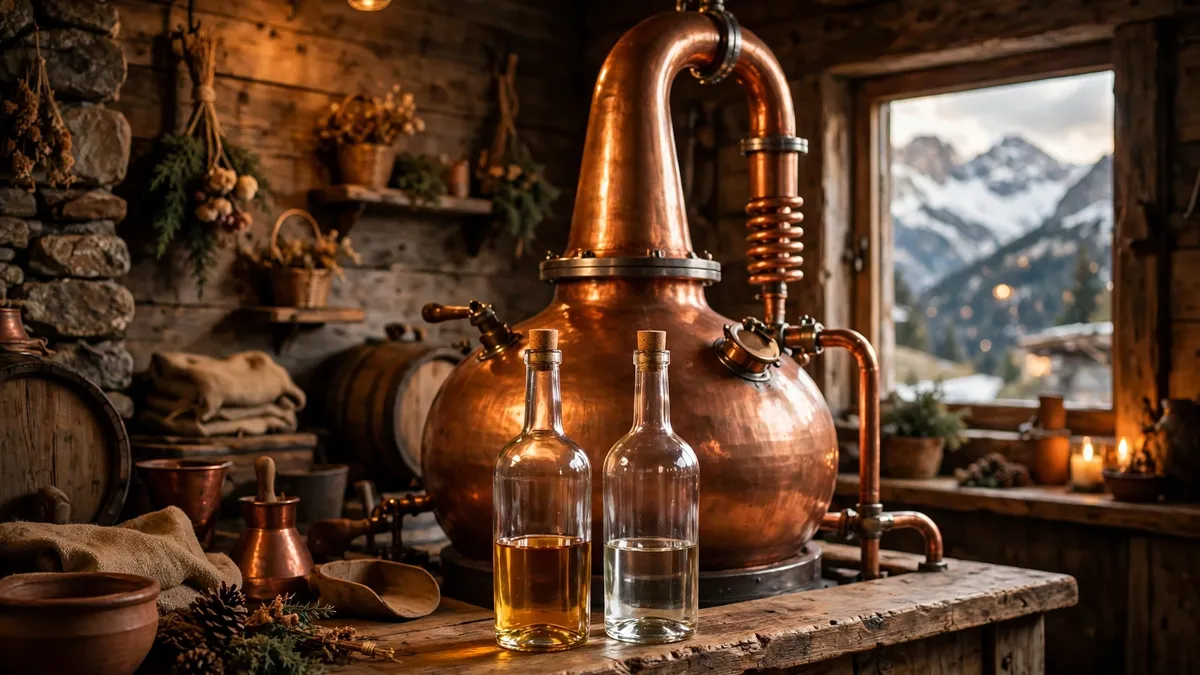
Main image: AI illustration.
Two bottles stand side by side on the distillery shelf, and the labels look like cousins.
One pours sweet and syrupy, the other dry and sharp, and the difference is a single ingredient.
Sugar decides it: a liqueur carries sugar, an eau-de-vie carries none.
At the Distillerie des 4 Frères, both kinds come from the same copper still, a short walk from Le 1420.
Alcohol abuse is dangerous for your health. Drink in moderation.
Liqueur vs Eau-de-Vie in Short
- A liqueur is a distilled spirit sweetened with sugar and flavoured with fruit, herbs, or plants.
- An eau-de-vie is pure distillation of fermented fruit, with no sugar added at all.
- The 4 Frères brothers run a still from 1921 in La Salle-les-Alpes, a short walk from the bar.
- Mélèze, framboise, verveine citronnée, and génépi fill the liqueur list.
- Their best-known eau-de-vie, La Marmote, costs €40 a bottle at 42% alcohol.
- Visits run about an hour, with a tasting offered at the end.
The One Difference That Decides Everything
Sugar is the line, and it runs through the whole shelf.
Take a spirit, add sugar and flavour, and the bottle becomes a liqueur.
Distil fermented fruit and add nothing, and the bottle becomes an eau-de-vie.
Liqueurs run sweet and syrupy by design, and their strength usually sits between 20% and 40% alcohol (De Michellot, 2026).
Eaux-de-vie run dry and powerful, and the law sets their floor at 37.5% alcohol (De Michellot, 2026).
Taste the two back to back, and the contrast needs no explanation.
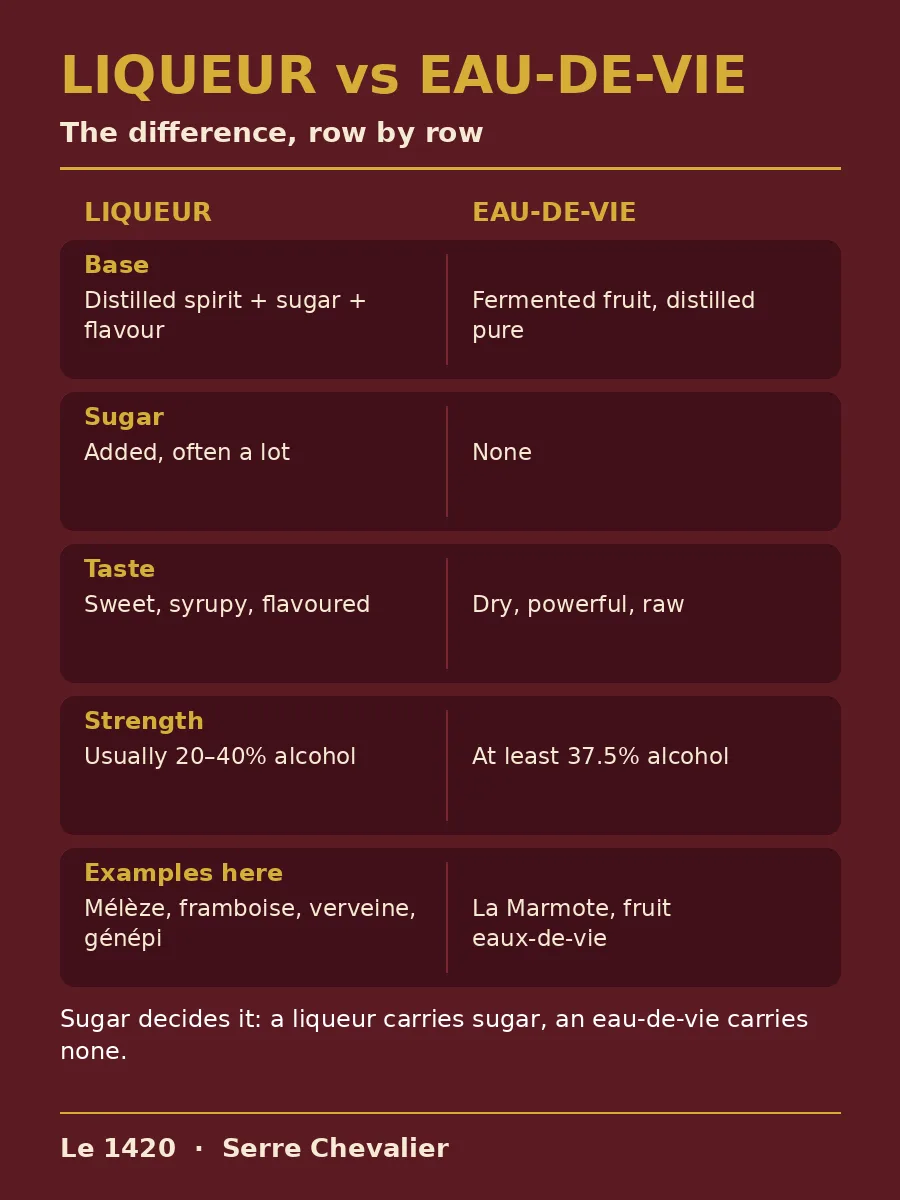
| Liqueur | Eau-de-vie | |
|---|---|---|
| Base | Distilled spirit + sugar + flavour | Fermented fruit, distilled pure |
| Sugar | Added, often a lot | None |
| Taste | Sweet, syrupy, flavoured | Dry, powerful, raw |
| Strength | Usually 20–40% alcohol | At least 37.5% alcohol |
| Examples here | Mélèze, framboise, verveine, génépi | La Marmote, fruit eaux-de-vie |
Liqueur vs eau-de-vie at a glance (Table 1). Definitions and strengths from De Michellot, 2026.
Sweetness misleads the nose: a framboise eau-de-vie smells of ripe raspberries and tastes bone dry.
That trick is the point: the fruit gives aroma, and only sugar gives sweetness.
How Each One Is Made
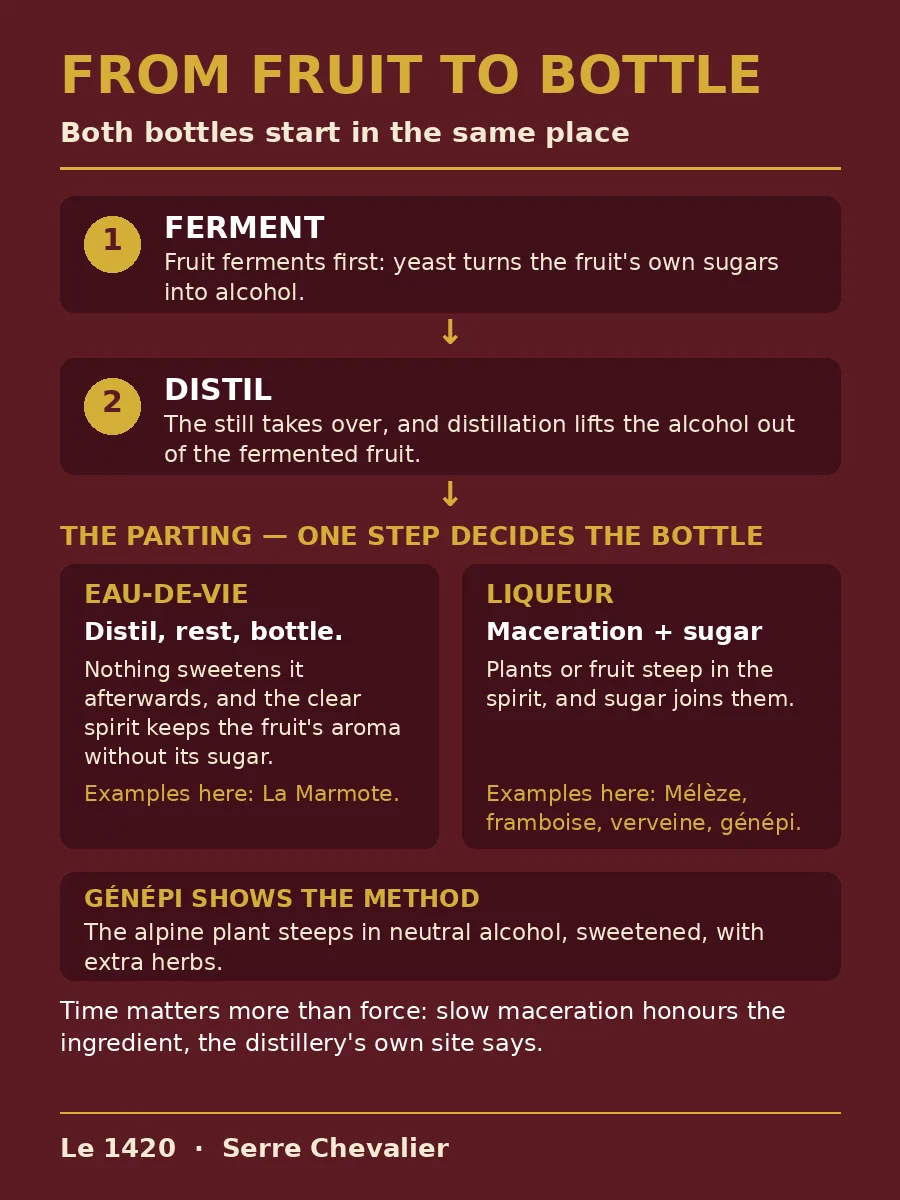
Both bottles start in the same place, and they part ways at the end.
Fruit ferments first: yeast turns the fruit’s own sugars into alcohol.
Then the still takes over, and distillation lifts the alcohol out of the fermented fruit.
That is nearly the whole story for an eau-de-vie: distil, rest, bottle.
Nothing sweetens it afterwards, and the clear spirit keeps the fruit’s aroma without its sugar.
For a liqueur, a second step follows: plants or fruit steep in the spirit, and sugar joins them.
Maceration draws the flavour out slowly, and the sugar fixes it in the bottle.
Génépi shows the method plainly: the alpine plant steeps in neutral alcohol, sweetened, with extra herbs (Food Republic, 2026).
Time matters more than force: slow maceration honours the ingredient, the distillery’s own site says.
The Brothers and Their 1921 Still
Four brothers run the place, and the still is older than all of them.
Brothers Sylvain and Nicolas Ribuot, with Bastien and Olivier, grew up in the Serre Chevalier valley (Village Artisanat, 2026).
Visitors may see the century-old copper still, dating from 1921, that the brothers open to them (Village Artisanat, 2026).
Everything they make starts from fruit, plants, and berries gathered locally by their own hands (Distillerie des 4 Frères, 2026).
From the purity of verbena to the power of juniper, each bottle reflects the Hautes-Alpes, the site says.
Liqueurs lead the range, and gin and eaux-de-vie stand beside them on the same shelf.
The Liqueurs on the Shelf
Four liqueurs carry the range, and each one names its plant.
Mélèze comes from the larch, a mountain tree whose young shoots flavour the bottle.
Framboise carries raspberry, bright and sweet, the softest introduction to the shelf.
Verveine citronnée brings lemon verbena, green and citrusy, the freshest of the four.
Génépi closes the set with the alpine plant itself, herbal and bitter-edged.
All four pour as digestifs, and all four suit a small glass after a meal.
Génépi’s own rules run deeper than the others, and its full story sits in the génépi guide: Génépi: The Alpine Liqueur in the Green Bottle.
The Eaux-de-Vie: La Marmote and the Rest
La Marmote is the bottle to remember, and the valley’s own plum makes it.
Only here grows the valley’s plum, Prune du Briançonnais, picked in late summer on the Serre Chevalier slopes (Distillerie des 4 Frères, 2026).
Distillation reveals its complexity, the distillery says: a fine, lively, authentic eau-de-vie.
It costs €40 a bottle at 42% alcohol, and the distillery’s own shop lists it out of stock today (Distillerie des 4 Frères, 2026).
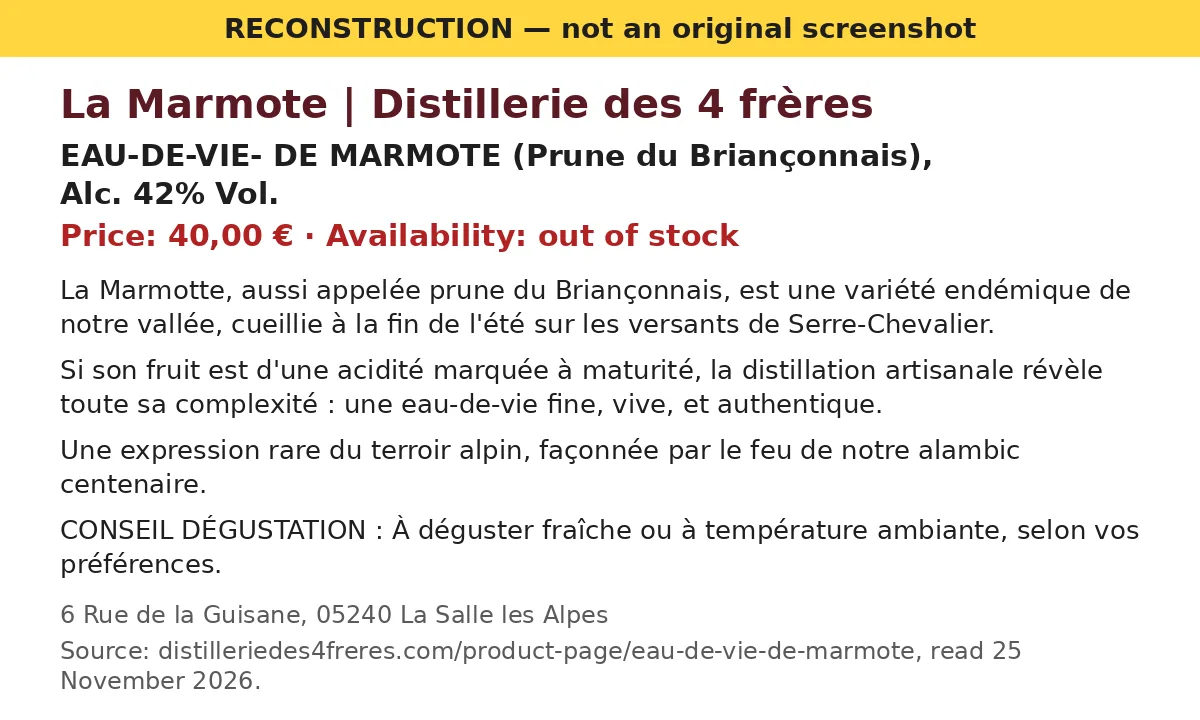
Serve it chilled or at room temperature, the distillery advises, according to your preference.
Other fruit eaux-de-vie fill the rest of the shelf, each one named for its fruit.
No sugar softens any of them, and the fruit’s aroma does all the talking.
One bottle breaks the pattern on purpose: Le Dahu, the house mystery drink.
Two spirits meet in Le Dahu: liqueur and eau-de-vie, the recipe kept secret (Village Artisanat, 2026).
Tasting the Difference at the Counter
Order the two side by side, and the lesson arrives in two sips.
Start with the liqueur: small glass, sweet, the flavour arriving with the sugar.
Then take the eau-de-vie: a tiny pour, dry, the same fruit returning without sweetness.
Sip, don’t shoot: both bottles reward a slow mouthful, and a gulp wastes the aroma.
Narrow glasses help the nose, and the distillery’s tasting pours come small for a reason.
Water between the two resets the palate, and a glass of it costs nothing to ask for.
Seasons decide the range, so check the counter for the fruit in season now.
Visiting the Distillery
Visitors find the still a short walk from the bar, and the door is open to them.
Find the shop at 6 Rue de la Guisane, 05240 La Salle-les-Alpes, steps from the bar (Distillerie des 4 Frères, 2026).
Visits run about an hour, in good humour, with a tasting offered at the end (Distillerie des 4 Frères, 2026).
Also at the still: gin workshops, for visitors who want to watch it work (Serre Chevalier tourist office, 2026).
In a workshop, visitors build their own gin recipe, distil it, and take a bottle home (Distillerie des 4 Frères, 2026).
Boutique hours run daily from 16 December to 14 April (Serre Chevalier tourist office, 2026).
From 1 July to 27 September, the boutique opens Tuesday to Sunday (Serre Chevalier tourist office, 2026).
Outside those months, check the door before walking over, because the hours follow the season.
Which Bottle to Take Home
Sweet tooth, dry palate, or gift: the shelf answers all three.
Pick a liqueur when sweetness is the pleasure, and framboise is the gentlest start.
Pick an eau-de-vie when the fruit itself is the pleasure, and La Marmote is the valley’s own answer.
Le Dahu suits the mystery-seeker, and the house secret does the talking.
For a gift, La Marmote carries the valley in its name: a plum that grows nowhere else.
Start with génépi for a first bottle: the plant, the altitude, the digestif tradition.
Either way, buy at the distillery shop, where the brothers pour what they sell.
The Valley’s Shelf in Full
The distillery is one of four local makers, and the bar lines them up together.
Domaine Petit Août stands for the valley’s own wine, and the brewery pours its nine Tourmente beers.
Chartreuse stands further north, and the bar keeps ten bottles of it on the shelf.
Read the wine guide for the full shelf and how the four makers share it: Wine in Serre Chevalier.
Nine beers wait in the brewery guide, each with its strength, for the full range: La Tourmente: The Local Beer of the Hautes-Alpes.
Chartreuse in full, all four expressions, lives in the liqueur guide: Chartreuse: Green, Yellow, and V.E.P. — What the Mountain Liqueur Actually Is.
Frequently Asked Questions
What is the difference between a liqueur and an eau-de-vie?
A liqueur is a distilled spirit sweetened with sugar and flavoured; an eau-de-vie is fermented fruit distilled pure, with no sugar added (De Michellot, 2026).
Sweetness is the test: if the bottle tastes sweet, it is a liqueur.
How strong are the 4 Frères bottles?
Strength usually runs 20% to 40% alcohol for liqueurs, and eaux-de-vie start at 37.5% by law (De Michellot, 2026).
La Marmote, the best-known eau-de-vie here, stands at 42% alcohol (Distillerie des 4 Frères, 2026).
What is La Marmote?
An eau-de-vie from Prune du Briançonnais, the valley’s own plum, picked late in summer on the slopes of Serre Chevalier.
It costs €40 a bottle, and the distillery’s shop lists it out of stock today (Distillerie des 4 Frères, 2026).
Why is Le Dahu called a mystery drink?
Le Dahu is the house mystery drink, mixing liqueur and eau-de-vie, with the blend kept secret (Village Artisanat, 2026).
Ask at the counter: the brothers pour it, and the recipe stays theirs.
Is the distillery open to visitors?
Yes: visits run about an hour, with a tasting offered, at 6 Rue de la Guisane in La Salle-les-Alpes (Distillerie des 4 Frères, 2026).
Gin workshops run there too, and visitors take their own bottle home.
Methodology
Distillery facts come from the distillery’s own site and the Serre Chevalier tourist office, checked 25 November 2026.
Definitions and strength ranges come from De Michellot’s eau-de-vie guide, checked the same day.
Prices are the distillery’s own listed prices, with the date checked; La Marmote was out of stock when checked.
No bottle was bought or tasted for this article, and no purchase is recommended.
Every fact above was checked by hand against its source in References.